

For a decade, "AI in customer support" meant a decision-tree chatbot that deflected tickets and frustrated customers. That era is over. A new generation of autonomous AI agents can read context, call internal systems, take actions, and resolve requests end to end not just answer FAQs. The difference is architectural, and getting it right is what separates a demo from a system you can put in front of millions of customers.
From deflection to resolution
Traditional bots optimize for deflection keeping a ticket away from a human. Agents optimize for resolution actually completing the customer's goal. That shift changes every design decision, from how you measure success to how you connect the model to your systems of record.
The core idea
An AI agent is a language model wrapped in a loop: it observes the request, decides on an action, calls a tool, observes the result, and repeats until the goal is met or it escalates. The model reasons; your tools do the work.
The reference architecture
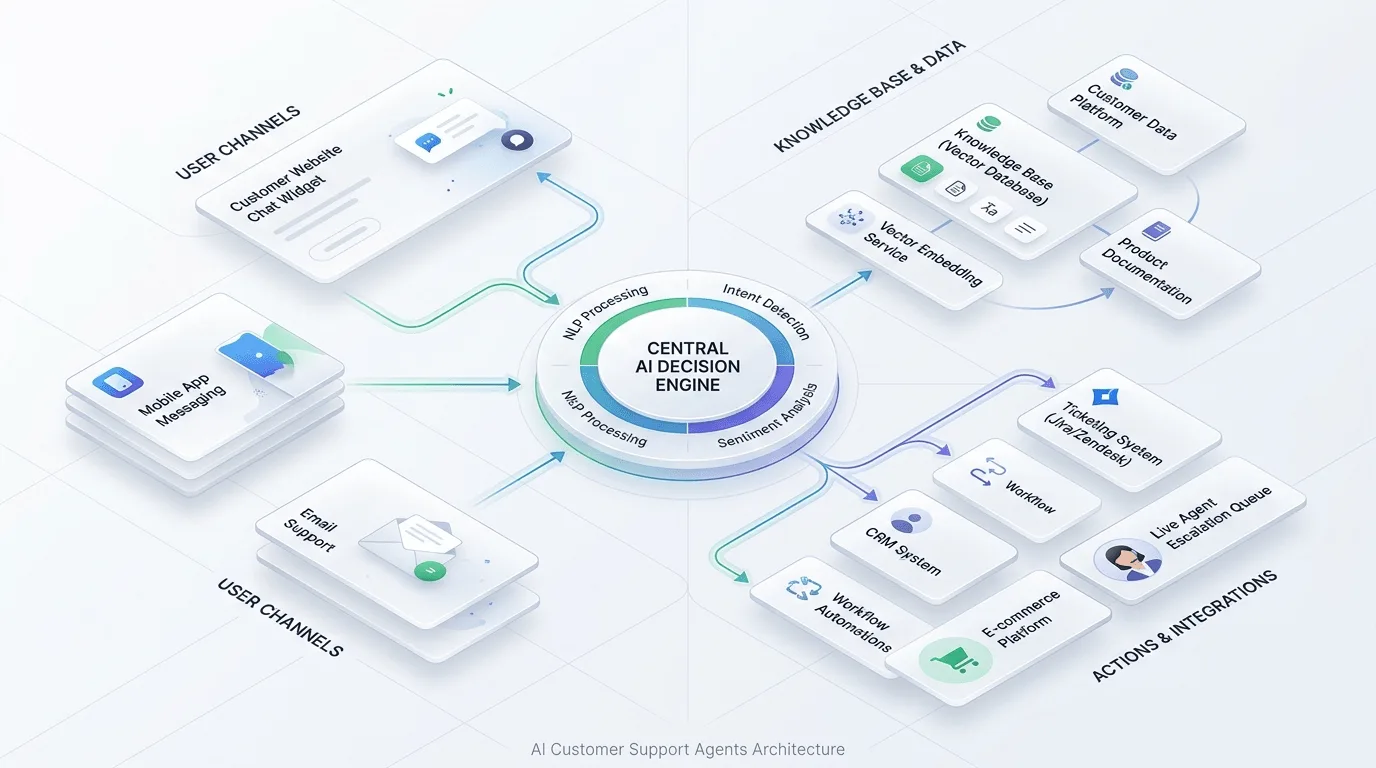
A production support agent has five layers. Each one is independently testable, which is what makes the system reliable enough for the enterprise.
- Channel layer chat, email, voice, and in-app widgets normalize into a single conversation format.
- Orchestration layer the agent loop: planning, tool selection, and escalation logic.
- Knowledge layer retrieval over your docs, policies, and past tickets (RAG) so answers are grounded.
- Action layer typed tools that read and write to CRM, billing, orders, and identity systems.
- Guardrail layer validation, PII handling, and confidence checks before any response or write.
import { Agent, tool } from "@/lib/agent"
import { z } from "zod"

const lookupOrder = tool({
 description: "Look up an order by its ID for the current customer",
 parameters: z.object({ orderId: z.string() }),
 execute: async ({ orderId }, { customerId }) => {
  // Always scope reads to the authenticated customer.
  return db.orders.find({ id: orderId, customerId })
 },
})

export const supportAgent = new Agent({
 model: "openai/gpt-4.1",
 system: "You are a support agent. Resolve the request or escalate. Never guess order data.",
 tools: { lookupOrder },
 maxSteps: 6,
})
Never let the model invent facts
Order status, account balances, and entitlements must always come from a tool call scoped to the authenticated user never from the model's memory. Ground every factual claim in a system of record.
What actually moves the metrics
When teams measure the right things, a well-built agent changes the economics of support. The gains come from resolving routine requests instantly and freeing humans for the complex, high-empathy work.
Typical outcomes from a well-scoped rollout
Measure resolution, not deflection
| Legacy metric | Agent metric | Why it matters |
|---|---|---|
| Containment rate | True resolution rate | Deflection hides unsolved problems |
| Response time | Time to resolution | Customers want the goal met, not a fast reply |
| CSAT on bot | End-to-end CSAT | Measure the whole journey, including escalation |
The best support agent isn't the one that answers the most tickets. It's the one that knows exactly when to hand off to a human and gives that human a perfect summary.
— Heli Datta, React Js Developer
The operating model
Technology is half the story. Teams that succeed treat the agent as a product: they review escalations weekly, expand its tools deliberately, and keep a tight evaluation suite so every change is measured before it ships.
Start narrow, then expand
Ship one high-volume, low-risk workflow first (order status, password reset). Prove the resolution rate and safety, then add tools one at a time. A narrow agent that works beats a broad agent you can't trust.
Where to start
If you are evaluating AI agents for support, begin with a readiness review: catalog your top ticket types, map the systems an agent would need to call, and define what "resolved" means for each. That groundwork is what turns a promising pilot into a dependable production system.