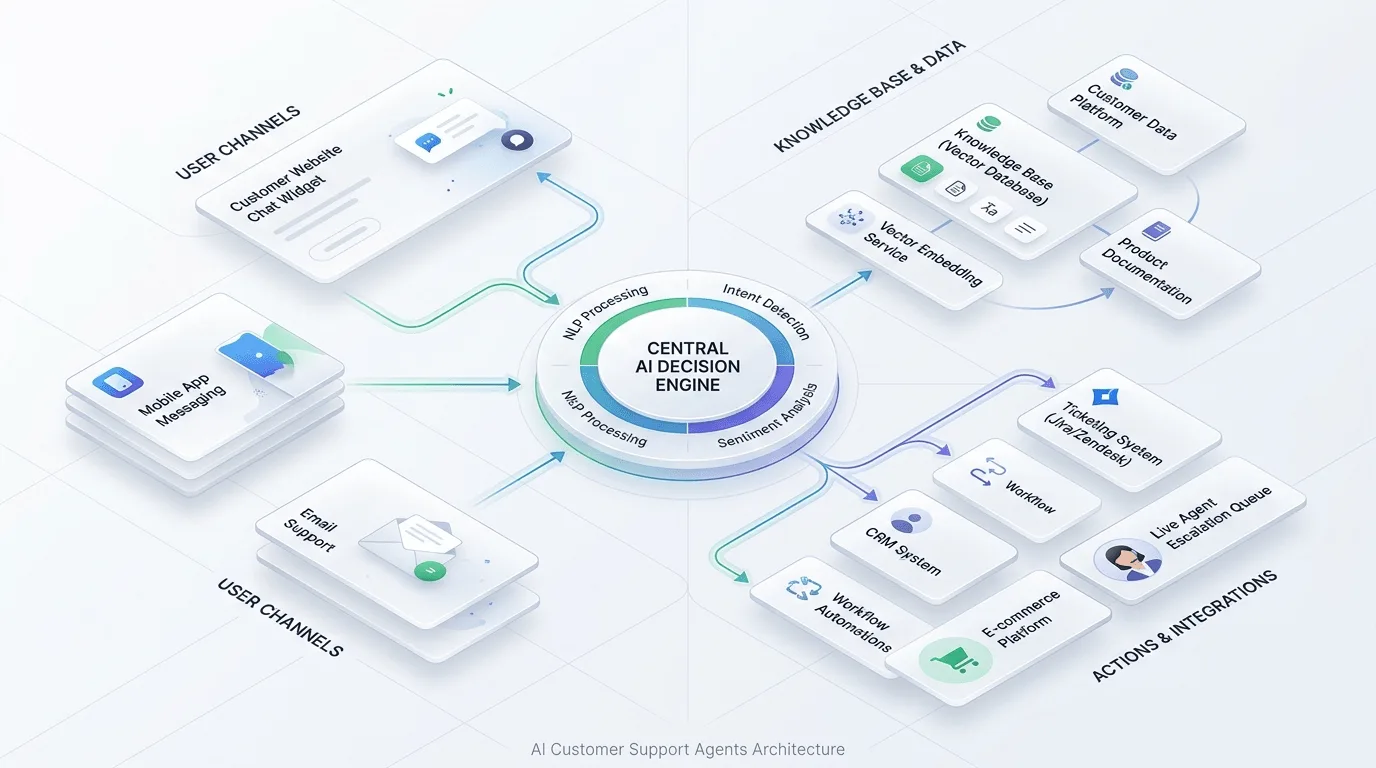



Effective data management and preparation are key in the process for companies en route to harnessing the power of data-driven insights in the age of digital transformation. It is an “Artificial Intelligence in Business” initiative through analytics and well-informed decision-making that requires a single view: the effective collection, storage, and management of data. This paper presents in-depth procedures for setting up data storage and collection, guaranteeing “data accessibility” and quality, and putting in place data governance and security measures.
Strategic Overview & Key Drivers
Technical Foundations & Requirements
“Establishing data collection and storage practices”
The establishment of effective “Data Collection Practices” is the very first step for data preparation. In such information, gleaned from several sources such as client communications, internal workflows, and outside databases, a comprehensive overview of the corporate landscape can be known. The important considerations in collecting data are:
- Clearly defining sources, categories, and frequency of data collection helps gain relevant and useful information.
- Integration solves the data silos issue and offers a one-of-a-kind view of data from several sources in one format for a proper process of analysis.
- After data is gathered it in some way has to be stored effectively and safely. Some good techniques to store your “data storage” are:
“Choosing the Best Storage Solution”
Considering the volume, variety, as well as velocity, choose the best options to store it, be it in the cloud, on-premises databases, or even hybrid systems.
- Protection as well as Recovery of Data: The strategies should develop the strategies for disaster recovery, which should always back up the data so that in case of any mishap or disaster, the data is not lost and the business process does not come to a halt.
- Scalability: This simply means that, as the volume of data increases, so does the performance and availability of the storage system.
“Ensuring data quality and accessibility”
Correct insights and wholesome judgments need good data. Several very important processes are brought under the aegis of "data quality management" to ensure this very feature.
- Data validation: This is a way to ensure that wrong and missing data are not fed into the system by inserting many checks and validation rules at times of entry and gathering the data.
- Standardization: Standard formats and definitions for the data that need to be maintained to ensure homogeneity within an organization.
Not only is "accessibility" of data to the right audience paramount, but the following are key processes:
- Data Cataloguing: Data cataloging involves indexing and organizing data assets through a data catalog so that users can find information easily.
- User-Friendly Tools: This means providing easy-to-use tools and UI that empower users to access, explore, and analyze the data without deep technical expertise.
Implementing data governance and security measures
Engineering & Implementation Considerations
Execution Workflows & Best Practices
“Data governance” refers to that part of data management concerned with developing guidelines and protocols for data use, integrity, and security. Good data governance ensures responsible data management and compliance with regulations. Notable components of data governance include:
Data stewardship: Assign a data steward who should be in charge, oversee data management processes for the quality of data, and enforce governance policies. Design and implement data policies and standards concerning the collection, storage, processing, and use of data to ensure uniformity and compliance.
Management of metadata is the process of providing context and meaning to data to enhance data understanding and value.
Another critical aspect of data management is "data security," providing safeguards against threats, breaches, and unauthorized access to, information. Principal safety measures include:
Both data at rest and data in transit have to be encrypted to avoid any unauthorized access and ensure the confidentiality of the data.
Access Control: Permission and authentication procedures will be developed as strong measures to restrict who may have access to data and the activities they can perform.
Regular security audits and monitoring for any anomalies that may give rise to a potential security incident being identified and acted on about the access and usage of data.
Conclusion
Data preparation is of prime importance for artificial intelligence-based algorithms and models. It is the act or process of making raw data perfect in a dataset so it is ready for AI applications. This could involve reducing the amount of data, filtering noisy or outlier data points, scaling or normalizing data, and transforming data into various shapes. It could also involve setting up data that will be fed into some AI strategy algorithm or model, in which case datasets are labeled and categorized in some way.
Business Outcomes & Future Outlook
Proper data preparation is the key to developing dependable and accurate Artificial Intelligence models. It therefore cannot be dispensed with in any AI project, however small the scope or complexity of the problem being addressed. For instance, in the development of efficient artificial AE algorithms with good models of practical applications, proper data preparation can be the difference between success and failure.